Po osmi letech od vydání verze 2.0 byla vydána nová major verze 3.0 multiplatformního editoru tagů MusicBrainz Picard (Wikipedie). Přehled novinek, vylepšení a oprav v changelogu.
Mezinárodní federace hudebního průmyslu (International Federation of the Phonographic Industry) navrhla Evropské komisi zařazení populárního open-source nástroje yt-dlp na evropský seznam 'padělků a pirátství' (EU Counterfeit and Piracy Watch List) pro rok 2027 (plné znění žádosti IFPI). IFPI ve svém podání označuje tento aktivně vyvíjený a o rozličné funkce bohatší fork youtube-dl za 'závažný problém' pro hudební průmysl, v
… více »Byla vydána nová verze 7.4 linuxové distribuce Parrot OS (Wikipedie). Jedná se o linuxovou distribuci založenou na Debianu a zaměřenou na penetrační testování, digitální forenzní analýzu, reverzní inženýrství, hacking, anonymitu nebo kryptografii. Přehled novinek v příspěvku na blogu.
Dnes startuje desátý ročník oblíbené kyberbezpečnostní soutěže The Catch organizované Forenzní laboratoří CESNETu. Letos zavede soutěžící do světa národních výzkumných a vzdělávacích sítí (NREN). Čekají na vás tematické úlohy založené na principu Capture the Flag (CTF), hledání ukrytých flagů i zajímavé ceny. Otestujte své schopnosti a vyrazte na lov flagů.
Byly zpracovány a na YouTube zveřejněny videozáznamy z konference LinuxDays 2026.
Německý startup Aleph Alpha k příležitosti výročí sjednocení Německa zveřejnil open-weight jazykový model Kolibri, vyvíjený s ohledem na unijní pojetí autorského práva, ochranu osobních údajů GDPR a nařízení EU o umělé inteligenci, jehož 'Kodexu správné praxe' je Aleph Alpha signatářem. Výsledkem tohoto přístupu je transparentnější technologie, kterou například budou moci využívat evropské veřejné instituce, ovšem za cenu
… více »Nvidia zveřejnila návrh nové bezpečnostní platformy pro nasazování AI agentů. Jedná se o nasazení AI za použití OpenShell a Sentry, dvou oddělených bezpečnostních vrstev, v nichž může Sentry monitorovat a vyhodnocovat chování AI v OpenShellu tak, že ho v krajním případě až vypne. Mělo by to zabránit dalším únikům AI ze sandboxu.
Přímý přenos (YouTube) z konference LinuxDays 2026, jež probíhá tento víkend v Praze v prostorách FIT ČVUT. Na programu je spousta zajímavých přednášek.
Byla vydána nová verze 0.17.0 programovacího jazyka Zig (Codeberg, Wikipedie). Přispělo 206 vývojářů. Přehled novinek v poznámkách k vydání.
Open-source projekt OpenDLSS-NR je 'bitově přesná reimplementace' neuronové rendrovací sítě DLSS 5 od společnosti NVIDIA, jenže pro grafické API Vulkan (DLSS slouží k vylepšování klasickým způsobem vyrendrovaných snímků pomocí lokálních modelů umělé inteligence, a to v reálném čase). Projekt není nijak spojen se společností NVIDIA, je pouze pro OS Windows a natrénované váhy modelu si uživatelé musí obstarat sami. Zdrojový kód je k dispozici na GitHubu, pod licencí MIT s výjimkou pro komponenty třetích stran.

Autor: Daniel Vrátil
Nasledovný príspevok je študentskou prácou, ktorá vznikla v rámci predmetu Advanced Topics of Linux Administration. Predmet je vypisovaný na Fakulte informatiky MU v spolupráci so spoločnosťou Red Hat Czech. Vyučovacím jazykom je angličtina a preto je v nej aj nasledovný príspevok, študent nemá právo výberu iného jazyka. Komentáre k obsahu príspevku sú vítané v ľubovoľnom zrozumiteľnom jazyku.
This article aims to provide introduction to programmatic use of Libvirt through it's C API.
Libvirt is a toolkit that allows programmers to control virtual machines running under different hypervisors through common API. At this moment Libvirt supports QEMU, Xen, LXC, OpenVZ, UML, VMWare and Microsoft Hyper-V.
The design is that application connects through libvirt to a libvirtd deamon (local or remote), which controls it's local (from daemon's point of view) virtual machines through libvirt. Libvirt itself consists of the user-side API and backends, which essentially translate the libvirt API calls into hypervisor-specific commands.
A lot has been written about libvirt(d) and how to install, configure it and how to use it's management tools, but less about how programmers can utilize it. Simple management tasks can be done through console applications like virsh (which supports both interactive and non-interactive mode). But sometimes programmer or administrator might want to watch a libvirtd server and be notified about events. This cannot be achieved through the console application and one must resort to use of Libvirt API.
When it comes to programming, hands-on approach is always better then cheap talks. I will demonstrate use of Libvirt's API on an application I have written for this article. Libvirt officially offers native C API and Python bindings, but 3rd party bindings for Ruby, PHP, Perl, Java, C# and OCaml are available too. I have decided to use the native C API and write a KDE Plasma Applet and DataEngine in C++/Qt to demonstrate use of Libvirt in event-driven environment.
I will not go into much detail of the Plasma-related code, there are numerous articles about it, including this serial (in Czech) here on ABCLinuxu. The Plasma applet is written completely in QML and is there only to visualize data, the libvirt interaaction is implemented in a DataEgine.
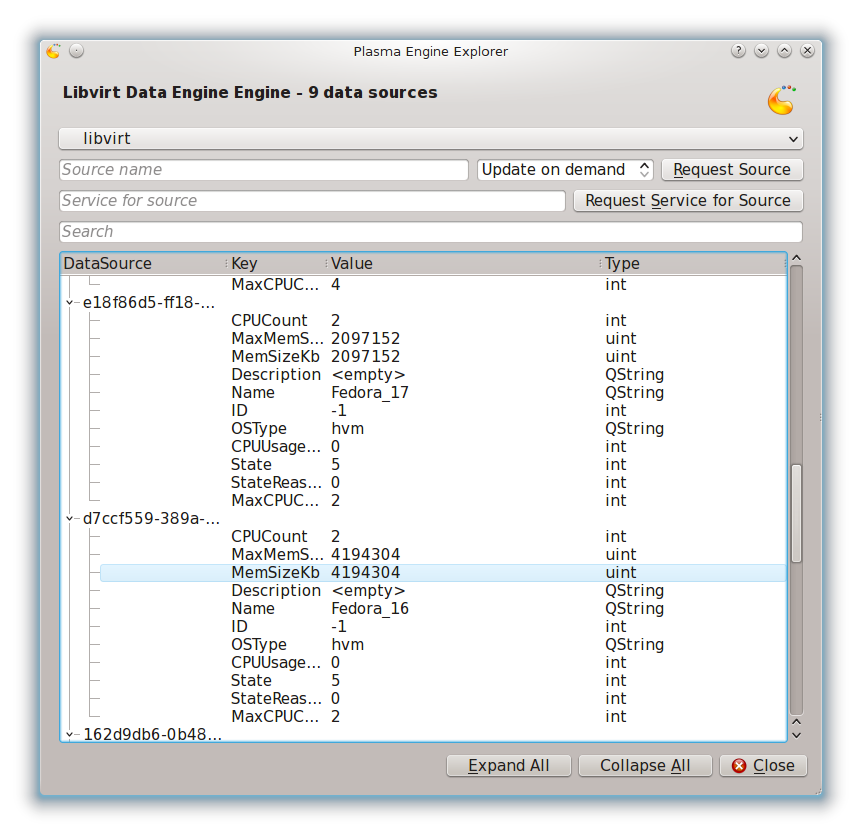
The DataEngine is completely written in C++. It is a sort of a backend where each virtual machine is provided as a Source. Visualizers (like the applet) can connect to one or more sources and poll them for changes or let themselves be notified about changes. Each Source is essentially a hash map property => value. Every Source can also have so called services which visualizers can invoke to let the DataEngine perform an action or change a property of a Source.
Libvirt offers two ways how to be notified about changes. Either by polling or by event notifications. I have decided to use event notifications, because polling causes unnecessary load on server and network. Libvirt comes with it's own implementation of an event loop, so that it can easily be used in applications without any other event-based framework (Qt, Glib, ...). The elementary use is same as with any other event-based application:
int main(int argc, char **argv)
{
  /* initialize libvirt */
  virInitialize();

  /* connect to server */
  virConnectPtr conn = virConnectOpen(....);

  /* initialize event loop */
  virEventRegisterDefaultImpl();

  /* connect callbacks to events */
  ....

  /* process events in a loop */
  quit = false;
  while (!quit) {
    virEventRunDefaultImpl();
  }

  /* disconnect callbacks */
  ....

  /* disconnect from server */
  virConnectClose(conn);

  return 0;
}
Problem arises if you try to use Libvirt's events implementation together with an another event-based
framework. For this situation Libvirt offers virEventRegisterImpl() to which user can pass
callbacks for registering, modifying and removing handlers and timeouts. User then have to implement
handling of the handlers and timeouts in the other event loop. In Qt, it would be possible to
reimplement QAbstractEventDispatcher
to do this. Unfortunately DataEngines are just a plugins run by Plasma desktop and we can't change the
event dispatcher on runtime. An alternative approach if you want to save some work, is
to use the original virEventRegisterDefaultImpl() in separate thread.
void LibvirtEventLoop::run()
{
    /* Initialize libvirt event loop */
    virEventRegisterDefaultImpl();

    /* Setup separate connection */
    virConnectPtr connection = virConnectOpen("qemu:///system");

    /* Make sure the connection stays alive in case there were no events for some time */
    if (virConnectSetKeepAlive(connection, 5, 3) < 0) {
        virConnectClose(connection);
        return;
    }

    /* Connect event handlers here */
    .....

    m_stopMutex.lock();
    while (!m_stop) {
        m_stopMutex.unlock();


        /* Die another day */
        if (virConnectIsAlive(connection) != 1)
            break;

        /* Process all queued libvirt events */
        if (virEventRunDefaultImpl() < 0) {
            m_stop = true;
        }

        m_stopMutex.lock();
    }
    m_stopMutex.unlock();

    /* Disconnect event handlers here */
    ....

    /* Disconnect from server */
    virConnectClose(connection);
}
The thread has it's own connection to server and will notify the main thread (which has it's own connection too)
through standard Qt's slot/signal mechanism. The main thread then forces respective Source to update and notifies
visualizers (see LibvirtEngine::eventLoopEvent()).
To connect to event handlers, there are virConnectDomainEventRegister() and virConnectDomainEventRegisterAny()
functions. The first one notifies only about changes in domain (Libvirt term for a virtual machine) lifecycle.
The latter allows users to specify which type of events
they want to listen to and to specify domain for which they want to receive events (otherwise events for
all domains are delivered).
Now when we are notified about events, we need to actually get a list of the domains that are available.
The DataEngine has hardcoded connection to qemu:///system, which is a connection to global session of local libvirtd.
The protocol specifies hypervisor type. To obtain list of all available domains, one must query active (running) and
inactive domains separately. It's also worth noting, that domains in Libvirt can be uniquely identified by their name
(though that can change during runtime) and UUID (persistent). Only running domains have ID. virDomainGetID()
for inactive domain returns -1. The ID is incremental, but it reset to zero after every libvirtd restart.
LibvirtEngine::init())
    /* Get number of active and inactive domains */
    int numActiveDomains = virConnectNumOfDomains(m_connection);
    int numInactiveDomains = virConnectNumOfDefinedDomains(m_connection);

    char **inactiveDomains = (char **) malloc(sizeof(char *) * numInactiveDomains);
    int *activeDomains = (int *) malloc(sizeof(int) * numActiveDomains);

    /* Get IDs of active domains and names of inactive domains */
    numActiveDomains = virConnectListDomains(m_connection, activeDomains, numActiveDomains);
    numInactiveDomains = virConnectListDefinedDomains(m_connection, inactiveDomains, numInactiveDomains);

    for (int i = 0 ; i < numActiveDomains ; i++) {
        /* Lookup the actual domain object by it's ID */
        virDomainPtr domain = virDomainLookupByID(m_connection, activeDomains[i]);
        /* Create a new Plasma DataContainer for each domain */
        addSource(new LibvirtSource(domain, m_connection, this));
    }

    for (int i = 0 ; i < numInactiveDomains ; i++) {
        /* Lookup the actual domain by it's name */
        virDomainPtr domain = virDomainLookupByName(m_connection, inactiveDomains[i]);
        addSource(new LibvirtSource(domain, m_connection, this));
        free(inactiveDomains[i]);
    }
The code above creates a new DataContainer (Source) for every domain. The sources are then exposed to visualizers via addSource().

The next task is to populate the sources with data from domains. We do it in LibvirtSource::dataUpdateRequested() slot,
which is called whenever anyone wants the Source to update. Elementary domain information are simple to retrieve, there are dedicated
functions for it, like virDomainGetName(), virDomainGetID() or virDomainGetState(). For example
memory configuration (soft and hard limit for VM memory allocation) can be obtained only from the XML description. Libvirt stores
configuration of every domain in a XML file which can be retrieved via virDomainGetXMLDesc(). To obtain a user's text description
of a domain, there is virDomainGetMetaData() function, but it throws a runtime warning when the domain does not have
any description (quite common case), therefor it's better to manually look into the XML for <description> tag and silently continue
when it's not there. The XML format is documented on Libvirt homepage.
It should be possible to query the domain for memory usage (e.g. amount of used memory within the VM), but it requires
some cgroups settings which didn't work for me, so the DataEngine does not report it. It is possible to get information
about CPU usage though - virDomainGetInfo() returns number of virtual CPUs allocated to the domain and total CPU time used
by all vCPUs (see LibvirtSource::updateCPUUsage()).
As mentioned in the beginning of the article, every DataEngine Source can also have a Service. Our DataEngine have a few simple services for changing state of a domain and it's memory size and CPU count.
To change a domain state, there is a specific method for every state to be invoked:
virDomainCreate(), virDomainCreateWithFlags(). Note that virDomainCreateXML() will create and start
a new temporary domain (a full XML description must be provided) which will be deleted upon shutdown.virDomainSuspend()virDomainResume()virDomainReboot()virDomainShutdown(), virDomainShutdownFlags() can specify whether to send an ACPI event or
initiate shutdown through guest agentvirDomainDestroy()virDomainSave() will save the entire domain state into provided filevirDomainRestore() will restore domain from a fileTo change number of virtual CPUs, virDomainSetVcpusFlags() is used. The flags specify whether the change should
affect only current session (if the domain is active at the moment) or whether it should be persistently written to domain
configuration. When VIR_DOMAIN_VCPU_MAXIMUM flag is provided, the hard limit is modified. virDomainSetMemoryFlags()
works analogically for domain memory allocation and the hard limit is set through virDomainSetMaxMemory().
It is of course possible to alter any other preferences. Some can be changed through dedicated API calls (for example storage pool
has quite an extensive API), some only by altering domain's XML description. To update domain's XML, virDomainDefineXML() can
be used. If the XML is missing UUID or has UUID of non-existent domain a new domain will be created. Finally, domains can be
removed by virDomainUndefine().
The Libvirt API is much more extensive, for full description see the official API reference and the Application Development Guide. If you were interested in a more detailed use of the Libvirt API, check Virt-Manager, which is written in Python and utilizes almost everything Libvirt can offer.
To see all the code above in context and in action, you can build the example application. Tarball with sources is available here,
git repository can be cloned from git://anongit.kde.org/scratch/dvratil/plasma-virt-monitor.




Tiskni
Sdílej:


 AbcLinuxu.cz
 ITBiz.cz
 HDmag.cz
 AbcPráce.cz